Northwood Space raises $375M at a $2B valuation to scale its satellite ground network
The Torrance company, which builds phased-array antennas and runs a shared ground network for satellite operators, raised its Series C from a16z, DFJ Growth and returning backers about nine months after a $100M Series B.
Northwood Space, a Torrance, California company that builds antennas and ground stations for talking to satellites, has closed a $375 million Series C co-led by Andreessen Horowitz and DFJ Growth. The round values the company at $2 billion, and it lands roughly nine months after a $100 million Series B.
Washington Harbour Partners, which led that Series B, came back with what Northwood called substantial follow-on money, alongside Alpine Space Ventures, Stepstone, In-Q-Tel and others. HSBC Innovation Banking is also providing a separate multi-year credit facility for working capital and network expansion. Payload reports that the new round brings Northwood's total capital raised to more than $500 million.
Why the ground is the bottleneck
Northwood's pitch rests on a simple mismatch. The company says active satellites grew from about 3,000 in 2020 to more than 14,000 by the end of 2025, while ground infrastructure to command those spacecraft and pull data down from them has not kept up. Axios, citing American Enterprise Institute data, puts today's count of operational satellites above 17,000.
Traditional ground stations are large, custom-built dishes that can take years to procure and install. Northwood instead makes standardized, modular hardware in its own factory and runs it as a shared network, so a satellite operator books passes rather than building its own station. CEO and co-founder Bridgit Mendler compared the model to cloud services, a common pool of shared infrastructure.
Two antennas and an API
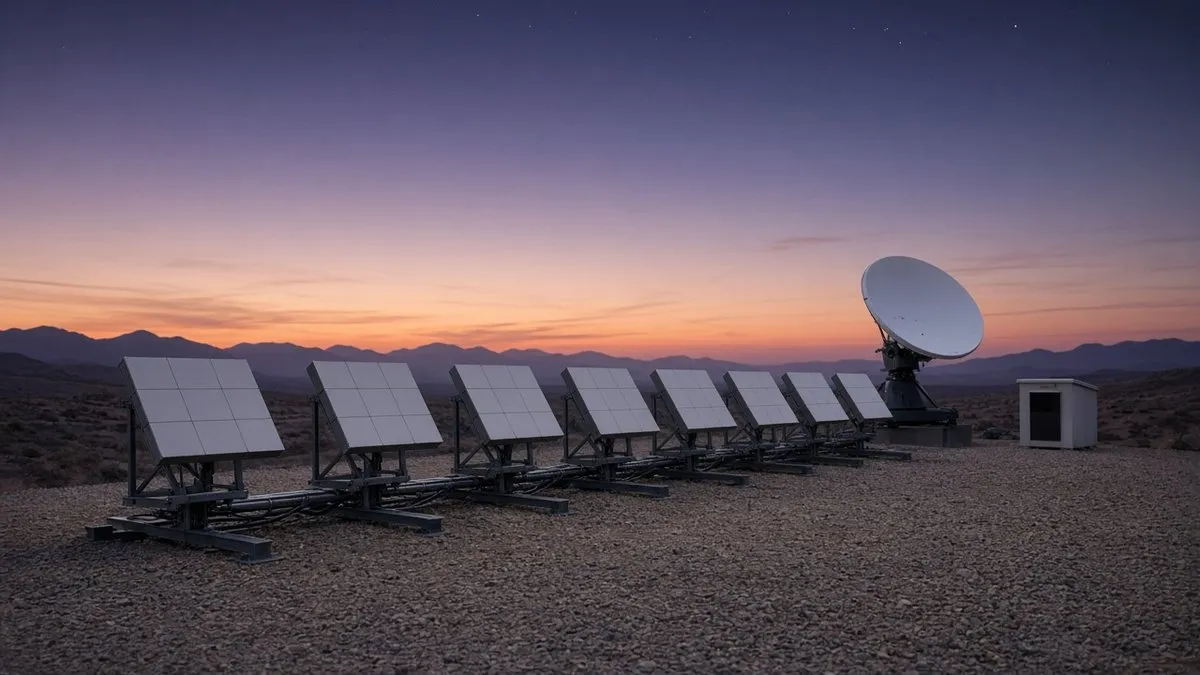
The company sells two product lines. Portal is an electronically steered phased array for command and control. It can hold links with six satellites at once, according to Satellite Today, and was designed to steer multiple beams electronically across low, medium and geostationary orbits without mechanical movement. Prism is a parabolic dish for high-throughput payload data, talking to one satellite at a time at multi-gigabit rates.
Northwood says its software can combine several antennas into one larger effective aperture. In a recent test it arrayed 10 Portals to match the receive performance of a 20-foot dish. The systems ship by standard freight and need only flat ground, power and fiber, and the company says a new site takes about three months, with antennas going from truck arrival to live links in three to four hours. Operators search, reserve, update and cancel passes through an API.
Between the two lines, Northwood built 29 units over the past year, Mendler told Satellite Today, and the goal is hundreds a year. To get there it recently opened a 185,000-square-foot headquarters and factory in Torrance. The company also says it has deployed six multi-orbit-capable sites on two continents since the Series B.
Government work and what comes next
Defense is a large part of the story. In January Northwood announced a $49.8 million Space Force contract to support the Satellite Control Network, the system the military uses to track and command satellites, including GPS spacecraft and satellites that are tumbling or lost after launch. Mendler said that work runs on Portal. The company also says it demonstrated a full-duplex link to a government geostationary satellite from a Portal site, delivered as a service in a Space Force prototype.
Venture interest in space and defense hardware has been running high, from Starfish Space's Space Force servicing contract to experiments such as Google running AI on a TPU in orbit. More satellites, and more computing in orbit, mean more data that has to come down somewhere, which is the market Northwood is betting on.
Mendler said the largest ground networks today have hundreds of sites and that Northwood plans to reach and surpass that scale. The company has about 140 employees and plans to add 400 jobs in Torrance and Washington, DC over three years. It is targeting sites capable of more than 100 gigabits per second in high-demand regions by the end of 2027, and says it will announce several site and network expansions in the first half of 2027.