Korea's export bank leads $200M Series C push for ammonia power startup Amogy
The Export-Import Bank of Korea will invest $20 million in Amogy and lead the ammonia-to-power startup's effort to raise $200 million, tying its mass-production push to Korean shipbuilders and suppliers.
The Export-Import Bank of Korea (KEXIM) said on October 26 that it will put $20 million directly into Amogy, a Brooklyn-based company that turns ammonia into electricity, and will act as lead investor in the startup's effort to raise $200 million in a Series C round.
The bank framed the deal as a way to tie Amogy's push into mass production to Korean manufacturers. According to The Asia Business Daily, KEXIM will lead negotiations on the investment terms and coordinate the participation of other investors. Neither side has disclosed a valuation, and the rest of the round has not been named, so the $200 million figure is a target rather than a closed raise.
How ammonia-to-power works
Ammonia is a molecule of one nitrogen atom and three hydrogen atoms. It is already shipped around the world in large volumes for fertilizer, and it is far easier to store and move than pure hydrogen, which has to be compressed or chilled to extreme temperatures. Amogy's approach is to carry hydrogen in that form and release it only at the point of use.
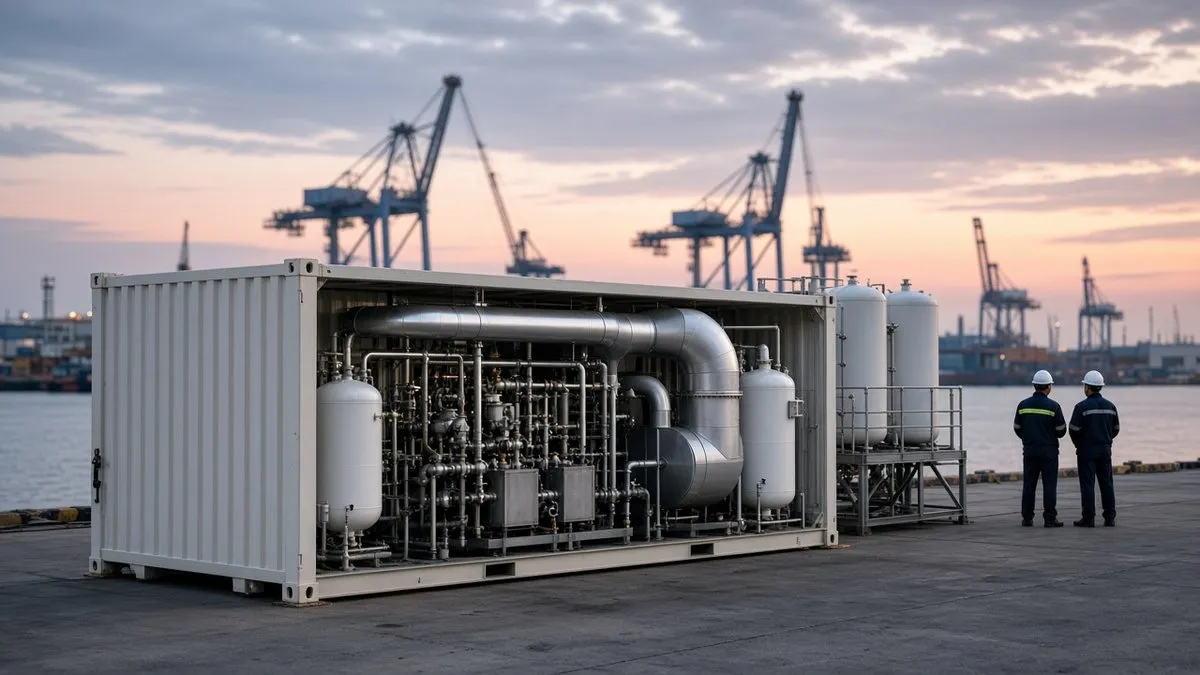
The company's system uses catalyst materials to "crack" ammonia on site into hydrogen and nitrogen. The hydrogen then feeds a fuel cell or a hydrogen engine, which produces power without carbon emissions at the point of generation, the company says. The units are modular and standardized, so several can be linked to match a site's electricity demand. Amogy has tested the setup in drones, tractors and trucks and has completed a demonstration of an ammonia-powered tugboat, according to the Asia Business Daily report.
The climate case depends on how the ammonia itself is made. Conventional ammonia production relies heavily on fossil fuels, the International Energy Agency notes, so the full-cycle emissions benefit grows as supply shifts toward low-carbon ammonia. That is a fuel-supply question outside Amogy's own hardware.
A Korean manufacturing base
Amogy was founded in 2020 by four Korean MIT doctoral graduates, and much of its commercial footprint now sits in South Korea. In November 2025, Samsung Heavy Industries signed a multi-year contract manufacturing partnership to build and test Amogy's systems at a dedicated Korean facility, starting with units for a pilot project in Pohang. Samsung Heavy had first invested in Amogy in December 2024, and the Korean press describes the deal as giving the shipbuilder exclusive production rights in Korea.
Amogy also contracts module production to smaller Korean suppliers, including energy plant equipment maker Wooyang HC and Tanktech, which builds safety equipment for ships and offshore plants, Daily Hankook reported. KEXIM said it expects the investment to help those small and midsize companies join global supply chains for clean power equipment.
The Pohang project is the clearest test of the business. In June, Amogy signed a supply agreement with Amun Energy, a GS Engineering & Construction company, for a distributed power plant that is to start with a 1 MW pilot system and scale to 40 MW of installed ammonia-based capacity by 2029. GS E&C had already backed Amogy with a $15 million strategic investment in November 2025, which the company said brought its total funding since inception to $315 million. Earlier backers include Amazon's Climate Pledge Fund, SK Innovation, Aramco Ventures, Mitsubishi Corporation and BHP Ventures.
Why a state lender is writing the check
KEXIM is a state-owned policy lender whose core business is export financing, not venture investing. The Amogy investment is its second direct stake in a venture company since amendments to the Export-Import Bank of Korea Act and its enforcement decree, following a KRW 20 billion investment in AI chip designer FuriosaAI, according to The Asia Business Daily. The bank has widened its direct investment targets to the seven "SEED" growth fields the government identified in August.
A KEXIM official said the investment is meant "to strengthen the carbon competitiveness of Korean industry in line with the government's Korea Green Transformation (K-GX) strategy, while helping create new growth engines for our traditional export industries." For Korea's shipbuilders and builders, ammonia power offers a way to sell fabrication and project skills they already have into a new energy market.
The deal adds to a wave of capital going into energy hardware and storage, a theme Venture Block has followed with Moment Energy's $40 million raise for repurposed EV batteries and ZincFive's planned SPAC listing. Amogy's approach differs in that it generates power from a stored fuel rather than storing electricity from the grid, which puts it closer to on-site generation than to a battery.
Amogy plans to use the Series C money to scale production of its power modules and speed up commercialization. The next public milestone is the Pohang pilot, which Amogy and its Korean partners have said is set to begin in 2026.