Anduril and Qualcomm unveil BlueChip, a US-assembled rugged laptop for government buyers
Anduril and Qualcomm unveiled BlueChip, a rugged Snapdragon laptop designed and assembled in the US for government and defense buyers. Orders open in 2027, though key parts such as the display still come from China.
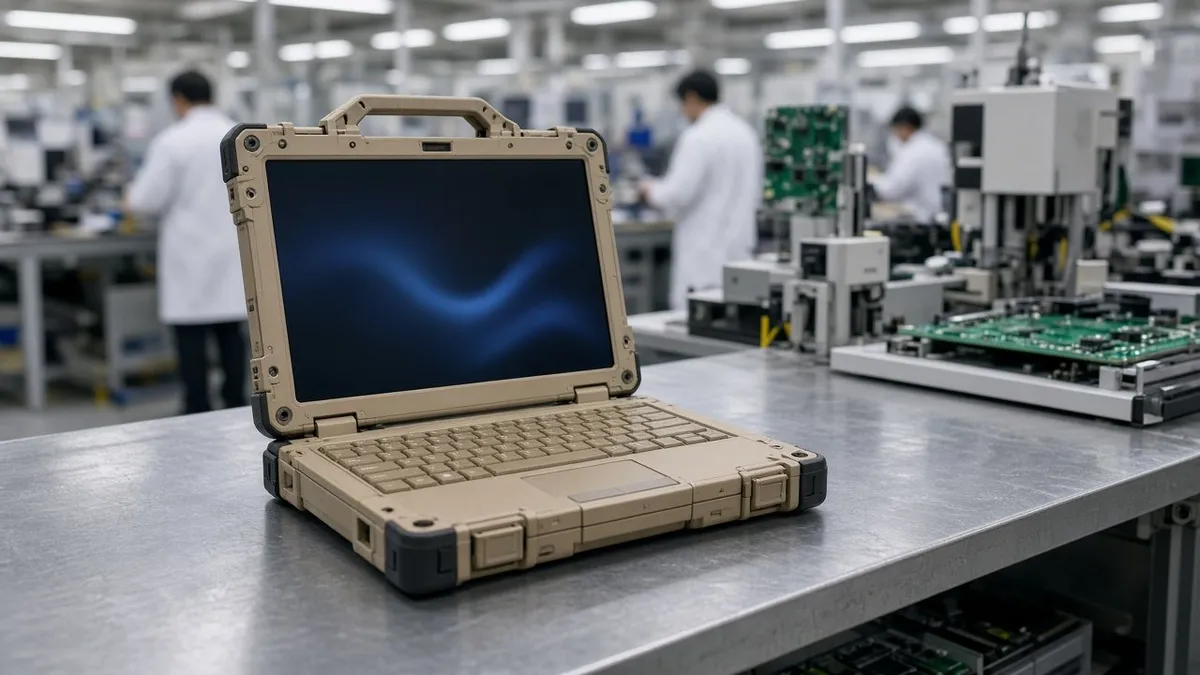
Anduril Industries and Qualcomm on Tuesday unveiled BlueChip, a new line of computers that starts with a rugged laptop designed and assembled in the United States and built around Qualcomm's Snapdragon X Series processors. The defense-technology company says it has working prototypes and plans to begin taking orders in 2027, with government agencies, the military, first responders and public-safety teams as the first customers.
The product is a departure for Anduril, which is best known for autonomous drones, sensor towers and its Lattice command software. The pitch is less about raw performance than about provenance: a laptop whose parts can be traced and audited by agencies that are required to buy American-made equipment.
What Anduril and Qualcomm are building
According to the companies' joint announcement, the Snapdragon chip handles general-purpose processing, graphics and on-device AI. Anduril says its engineers redesigned the enclosure so it can be machined in the United States, built the battery and power-management system around existing American battery technology, chose metals that US industry can produce at scale, and developed a bonding process for US-made display glass.
The prototype The Verge saw is an Arm-based, ruggedized machine with a carrying handle styled like a rifle strap. It runs Windows or one of two Linux distributions, and Anduril told TechCrunch it is making sure the machine handles Windows applications, government Linux builds and older legacy software. The hardening that makes it suitable for field use also makes it heavy and limits battery life, TechCrunch reported.
Anduril founder Palmer Luckey told DefenseScoop that Anduril's Lattice software has been integrated into BlueChip. DefenseScoop describes Lattice as the backbone for some of the military's high-priority modernization programs, such as Next Generation Command and Control. He also said the Qualcomm chips are "extremely good" for AI inference and that he has been using his own BlueChip to run models locally on information he is not allowed to send to the cloud. Qualcomm chief executive Cristiano Amon put it more broadly, telling DefenseScoop that "computers are also becoming token machines."
How American is it?
The supply-chain claim is where the details matter. Anduril says components from US and allied-country suppliers account for more than 90% of the prototypes' component procurement cost, and that it intends to reach a fully domestic supply chain in phases. Circuit-board assembly is planned for Arsenal-1, the company's manufacturing site in Ohio, which DefenseScoop notes is also where Anduril is building autonomous aircraft for the Air Force's Collaborative Combat Aircraft program.
Some key parts still come from overseas. Luckey told TechCrunch he had found a US supplier for the display cover glass, but the display itself is one of several components that, he said, are made only in China. Amon said the processors will be manufactured at TSMC's Arizona plant, according to The Verge.
Asked how much of the 2027 laptop will be American, Luckey told The Verge the share was still "TBD" and that "most likely the thing that we ship is not going to be 100-percent American." The Verge wrote that this sounds well below the 65% domestic-content threshold that federal procurement rules use for American-made goods. Anduril has not published a figure for the shipping product.
Who pays, and who buys
Anduril and Qualcomm are funding the work with their own research and development money and have received no government subsidies or contracts for BlueChip, Luckey told DefenseScoop. He declined to give production quantities, saying the company is running a very small line today and expects full-rate production next year. Pricing has not been announced, and Luckey estimated to TechCrunch that BlueChip will cost roughly 20% more than typical high-end PCs.
TechCrunch put the rugged-computer market at about $5 billion, which is small next to the consumer PC business but large enough to matter for a company that sells mainly to governments. Luckey framed the downside plainly to DefenseScoop: the worst case, he said, is that BlueChip becomes a low-volume laptop for critical industries and government. Consumers come last in the rollout, after defense and first responders, according to The Verge.
The launch fits a pattern of Anduril widening its footprint, from new engineering offices to a growing role in the Pentagon's push to bring commercial AI into the military. It also extends a broader trend of large technology companies designing more of their own hardware, as Microsoft has done with its Maia data-center chips. Whether BlueChip reaches the domestic-content levels Anduril is aiming for will depend on suppliers, displays in particular, that do not yet exist at scale in the United States. Agencies interested in the program can register with Anduril ahead of the 2027 order window.