Isomorphic Labs raises $5B to push its AI-designed drugs toward clinical trials
The Demis Hassabis-led drug designer raised a $5 billion Series C co-led by Greenoaks and Sequoia, six months after a $2.1 billion round, and still has not named a clinical candidate.
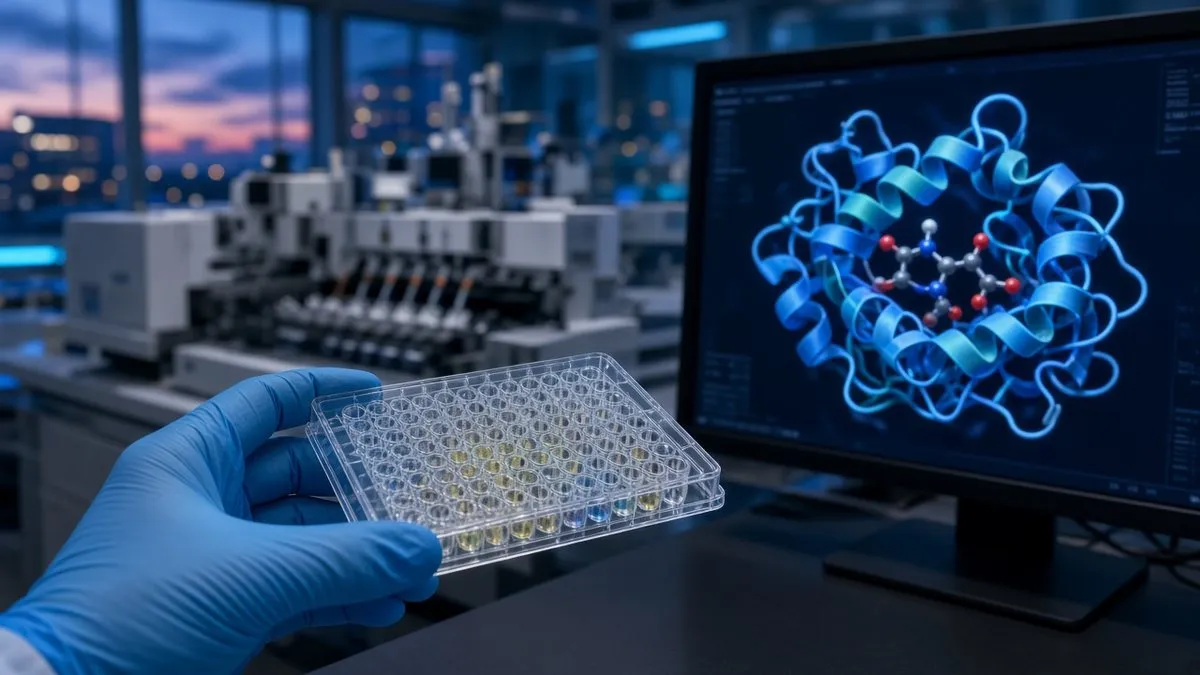
Isomorphic Labs, the Alphabet drug-design company run by Demis Hassabis, has raised $5 billion in a Series C round co-led by Greenoaks and Sequoia Capital. Andreessen Horowitz and several other new investors joined, Alphabet put in what the company called continued significant investment, and every existing backer took part: Thrive Capital, MGX, GV, CapitalG, Temasek and the UK Sovereign AI Fund. Isomorphic said the round was oversubscribed.
The London company did not disclose a valuation. Bloomberg reported earlier this month that the round would value it at about $50 billion, according to TechCrunch.
A fast climb with no disclosed drug yet
The size of the check stands out even by this year's standards. Isomorphic raised $2.1 billion in a Series B led by Thrive Capital only six months ago, in May, and took in $600 million in its first outside round in 2025. That puts its total at roughly $7.7 billion. BioSpace reports the Series C is the largest single private round the biotech industry has seen, ahead of the $3 billion Altos Labs launched with in 2022.
All of that money has gone in before Isomorphic has named a single drug candidate. The company says its own programs in oncology and immunology, along with partnered work, are producing positive preclinical results and "setting the stage for clinical entry." Its disclosed pharma partners are Eli Lilly, Novartis and Johnson & Johnson.
The clinical timeline has moved before. Hassabis had once talked about AI-designed drugs reaching trials by the end of 2025; in May the company said it expected its first trials by the end of 2026, and Hassabis told Bloomberg he had "misspoke" earlier and meant preclinical work, Quartz reported. This week he declined to give Bloomberg an updated target, saying the company is on track with its regulatory submissions and will have more to share in 2027, The Next Web reported. No regulator has yet approved a drug designed by AI.
What IsoDDE actually does
Isomorphic was spun out of Google DeepMind in 2021 to build on AlphaFold, the protein-structure model that earned Hassabis and John Jumper a share of the 2024 Nobel Prize in chemistry. Its core product today is IsoDDE, the Isomorphic Labs Drug Design Engine, which the company describes as a suite of simulation models that work across therapeutic areas and drug types, paired with in-house agents that reason over biological systems.
In a February technical update, Isomorphic laid out what the engine adds beyond AlphaFold 3. On the Runs N' Poses benchmark, which tests protein-ligand pairs that look nothing like the training data, the company said IsoDDE more than doubled AlphaFold 3's accuracy in the hardest category. On a set of 334 hard antibody-antigen structures, it reported 2.3 times as many high-quality predictions as AlphaFold 3 and 19.8 times as many as the open-source Boltz-2 model.
The engine also predicts binding affinity, meaning how tightly a molecule grips its target, a property drug designers work hard to optimize. Isomorphic said IsoDDE beat other deep-learning methods on three public benchmarks and could exceed free energy perturbation, the physics-based gold standard, without needing an experimental crystal structure. It can also flag hidden "cryptic" binding pockets from a protein's amino-acid sequence alone. The company showed it recovering a recently discovered pocket on cereblon, a protein that helps tag damaged or misfolded proteins for disposal, using only its sequence.
Sequoia partner Konstantine Buhler told Bloomberg the firm backed Isomorphic because the company has found scaling laws for its models, meaning performance keeps improving with more compute and data, The Next Web reported.
Where the $5 billion goes
According to the release, the money will fund further work on IsoDDE and new biology models, a partner network for studying disease mechanisms, global compute and bioengineering infrastructure, and the translational and clinical-development operation Isomorphic needs to run trials itself. Hassabis told Bloomberg the company has more than 20 programs underway, wants a platform that can produce "hundreds of drugs a year," and plans to move beyond small molecules into "pretty much all modalities," including large-molecule biologics.
"This round enables us to accelerate our progress: building foundational biology models, deepening our systemic disease understanding, and driving our first therapeutic programs towards clinical trials," Hassabis said in the release.
The raise is Isomorphic's first since Hassabis stepped back as DeepMind's chief executive in August. He is now DeepMind's chair and Alphabet's chief scientist, and remains Isomorphic's CEO, with Max Jaderberg as president. Asked about chip supply after Jensen Huang's resignation from Nvidia last week, Hassabis told Bloomberg the company has "very secure compute pipelines." Google designs its own AI chips.
The UK Sovereign AI Fund's return as an investor follows its recent bets on domestic AI companies such as chipmaker Fractile, and the round lands in a busy month for AI in health, after Oura agreed to buy Counsel Health. Isomorphic is headquartered in London with offices in Cambridge, Massachusetts, and Lausanne, Switzerland. Its next milestone is the first human trial of a drug its engine designed, which Hassabis has said the company will say more about in 2027.