Ukraine-founded UFORCE raises $700M at a $6B valuation to scale its sea drones
Valor Equity Partners and the UK's National Wealth Fund co-led the round, with the U.S.-Ukraine Reconstruction Investment Fund joining. The money goes mainly to expanding production of MAGURA boats and strike drones in Ukraine, the UK and other allied countries.
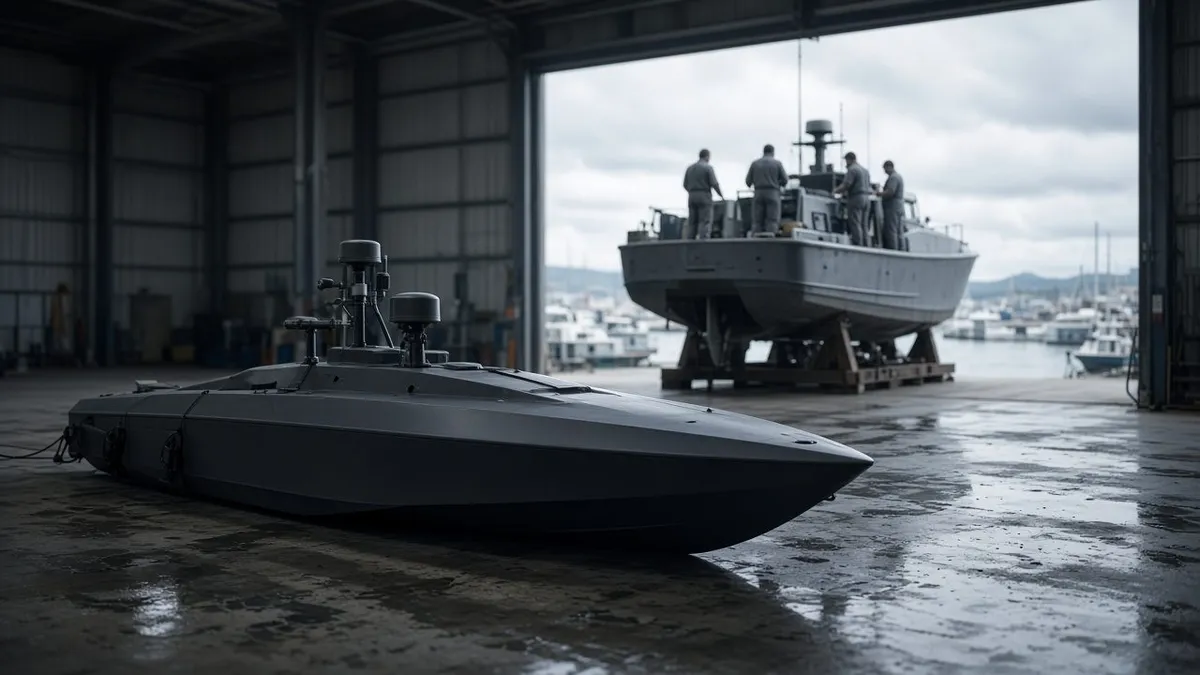
UFORCE, the Ukraine-founded maker of the MAGURA sea drones, has raised $700 million in a Series A round at a $6 billion valuation. Valor Equity Partners and the UK's National Wealth Fund co-led the round, which the company announced on November 12, with participation from the U.S.-Ukraine Reconstruction Investment Fund.
The size of the check is unusual for a Series A, and so is the cap table. Two of the three institutions named at the top are state-backed: one British, and one set up by Washington and Kyiv. The third is a U.S. growth fund. Axios reported the $6 billion figure as a post-money valuation.
Who wrote the checks
The National Wealth Fund said its share is a £113 million ($150 million) equity investment, its largest in defence to date. The fund said the money will scale British production of MAGURA boats (the MV7 and MV11 models) and NEMESIS strike drones, and that more than 70% of the content of each UK-built MV boat will come from British suppliers, including hulls, engines and electronics. UFORCE plans to add hundreds of engineering, software and manufacturing jobs in the UK.
On the U.S. side, the reconstruction fund's investment is earmarked for UFORCE's operations in Ukraine, including staff, research and new products. Conor Coleman, who leads investments at the U.S. International Development Finance Corporation, said in the company's announcement that the deal is the fund's largest in emerging technology so far.
New private investors include Menlo Ventures, Xantium and Hiro Capital. Existing backers Shield Capital, Ballistic Ventures, Lakestar and Squadra increased their stakes. Retired General Christopher Cavoli, the former NATO Supreme Allied Commander Europe and now a partner at Valor, joins UFORCE's board. Paul, Weiss advised Valor on the investment.
According to Axios, UFORCE started fundraising in June, and chief executive Oleg Rogynskyy declined to say whether any of the round is secondary, meaning shares sold by existing holders rather than new cash for the company. Sifted first reported in August that a large round was in the works.
What UFORCE builds
UFORCE was assembled as a roll-up: a July release said it combined nine Ukrainian defence technology developers and manufacturers into one London-registered company. Its catalog now spans every domain. MAGURA is a family of uncrewed surface vessels; NEMESIS covers aerial strike drones; LIUT is a line of ground robots; and PREDATOR is a turret family for shooting down drones. A command-and-control software layer ties them together, and the company describes its aim as making defence a hundred times cheaper than offensive operations.
The company's record claims come from combat in the Black Sea. UFORCE says MAGURA boats have contributed to the destruction of more than a dozen Russian warships and have shot down helicopters and fighter aircraft. It also says Ukrainian forces have used MAGURAs as mobile bases to launch NEMESIS drones at targets such as air defence systems, and that NEMESIS Class 1 heavy strike drones have flown more than 300,000 combat flights across more than 100 units. Those figures are the company's own and have not been independently verified.
From front line to factory floor
Most of the new money is aimed at manufacturing. UFORCE said it will spread production across the U.S., Europe, Asia-Pacific and the Middle East, building close to where systems are needed and keeping systems flowing to front-line troops despite continued attacks in Ukraine. It also plans to convert existing maritime and automotive plants for defence work.
In the U.S., that starts with boatbuilder ReconCraft. The two companies signed a memorandum of understanding in July to build MAGURA vessels in America, pairing ReconCraft, which builds combatant craft at its campus near Portland, Oregon, with UFORCE USA, the subsidiary led by Sean Plankey, a former senior adviser to the Secretary of Homeland Security. The pair also entered the U.S. Drone Dominance competition.
Rogynskyy framed supply, not competition, as the constraint. "Europe and the U.S. can only spend around 20% of what's been allocated because there isn't enough supply yet," he told Axios, adding that he does not see companies like Anduril as competitors.
A crowded month for defence tech
The round lands in a busy stretch for autonomous defence hardware. Earlier this month, Shield AI raised $2.5 billion to buy radar maker Echodyne, and Axon put $1.2 billion more into drone maker Skydio. In robotics more broadly, SoftBank led a $500 million round in Agile Robots.
UFORCE's pitch to investors and governments is that its products were developed and refined in active combat. The next markers to watch are the first UK-built MV boats and whether the ReconCraft partnership turns into U.S. contracts.