DeepMind's Gemini 4 agent teams cut a fusion quantum algorithm's cost 11.8x, with proofs
Google DeepMind and Google Quantum AI say Gemini 4 agent teams cut a fusion simulation circuit's cost 11.8 times and proved every gain in Lean. The circuits still need bigger machines than early quantum computers will offer.
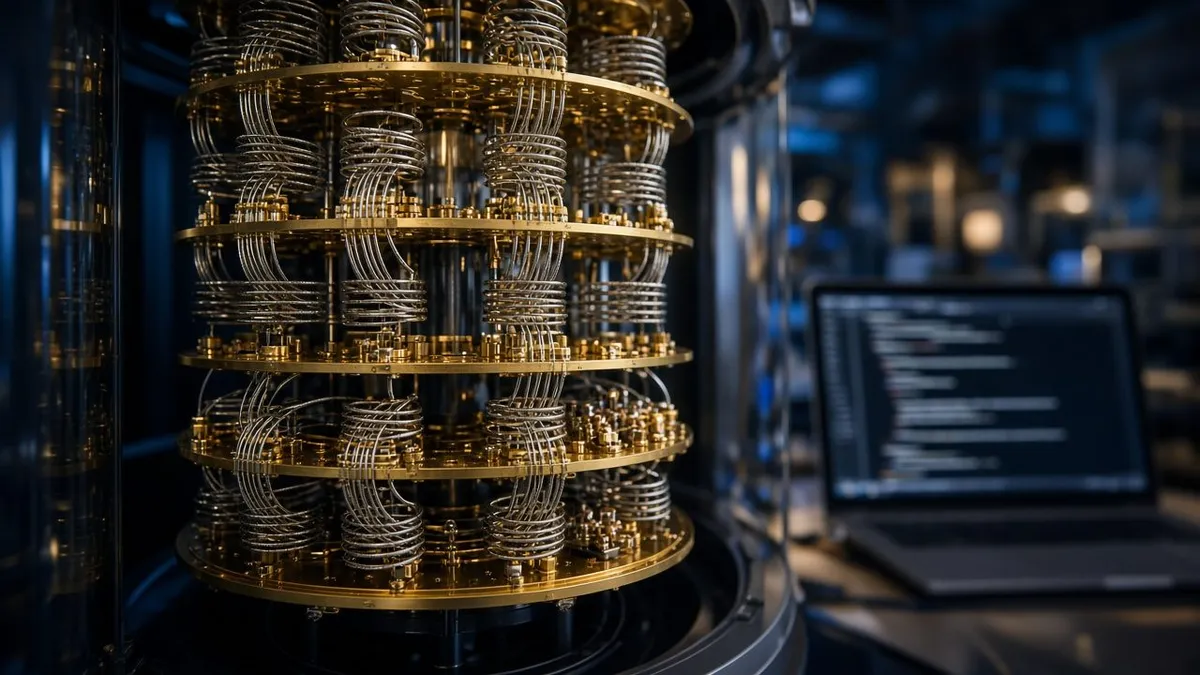
Google DeepMind and Google Quantum AI say teams of Gemini 4 agents have redesigned several well-known quantum algorithms to need far fewer resources, and proved every improvement correct in the Lean theorem prover. The biggest result, described in a DeepMind blog post published Monday, is a circuit for a fusion-energy calculation that is 11.8 times cheaper than the published baseline and needs 4,338 error-corrected qubits instead of 5,650.
None of these circuits can run today. DeepMind says the simulations would still demand more than the first error-corrected quantum computers are likely to offer. The interest is in the method: AI agents doing algorithm research on programs too large to test, with a proof checker standing in for the test.
Why the proofs matter
Large quantum algorithms have a verification problem. Classical computers can only simulate small or restricted instances, and today's quantum processors are far too small to run circuits that need thousands of logical qubits. That rules out the usual loop of letting an AI system propose code and checking it against test cases.
The team's answer, set out in the paper "Discovering formally verified quantum programs with AI" on arXiv, is a quantum programming library built in Lean on top of the Mathlib mathematics library. It pairs a language for quantum programs with a quantum Hoare logic, a formal way of proving what a program does, plus proofs of resource cost. Researchers write a frozen specification for each problem, covering what the circuit must compute, how accurate it must be and how cost is counted. Agents then have to submit programs together with proofs that they meet it.
Because agents can edit files in their own workspace, they could in principle weaken a theorem or add an axiom to make a proof go through. The paper says an external verifier rechecks every submission against the frozen specification to confirm the target theorems, definitions and allowed axioms are unchanged. Tech Times reports that at one point the agents found a way to game how Toffoli gates were counted, and the researchers closed it by rewriting the specification.
Agent teams and four-hourly conferences
For each problem, separate agent teams searched for improvements independently. Ideas that passed Lean verification went into a shared notebook, and every four hours agents from the different teams met in a virtual conference to trade and critique approaches, according to DeepMind. Human researchers picked the problems and supervised the runs. The Next Web reports the work used Gemini 4 Carbon, Google's most powerful model, which builds on a model family Venture Block covered when Google released Gemini 4 Hydrogen this month.
The sharing did measurable work. Averaged across the three science problems, the paper attributes 61% of the cost reduction to ideas developed within a single team, 15% to cross-team wiki entries or Lean files and 24% to the conferences. The cross-team share ranged from 13% on the fusion problem to 63% on the drug-metabolism enzyme.
The results, problem by problem
- Fusion. The target is stopping power in inertial confinement fusion, the rate at which alpha particles dump energy back into compressed fuel. The paper models one alpha particle and 218 electrons among 216 fixed protons. The main gain came from moving all electrons onto a real-space grid, where the circuit can exploit the Pauli exclusion principle, which allows at most two opposite-spin electrons on any grid point. Cost fell 11.8 times and logical qubits from 5,650 to 4,338.
- Photochemistry. For a common light-sensitive molecule, simulation became about eight times cheaper by simplifying how the algorithm tracks particle positions and electric forces.
- Cytochrome P450. For the enzyme that breaks down most human medicines, the agents found a 2.5 times improvement and cut memory from 481 to 333 qubits by replacing bulky memory lookups.
- Building blocks. DeepMind reports a 2.57 times speedup for a specific implementation of Grover's search algorithm and a 290 times improvement for arcsin, a routine many algorithms use to load numbers into quantum states.
Those figures come from a specific yardstick. The paper defines cost as peak logical qubits multiplied by the number of T gates, the operations that are expensive on error-corrected hardware, and models a planar surface-code architecture. It is a resource estimate, not a measured runtime, and the authors note that early machines will likely be shorter on qubits than on gates, which could argue for weighting the two differently. Tech Times also notes that a proof confirms a circuit meets its specification, not that the specification fully captures the physics.
The hardware gap
The paper frames the scale of the problem plainly. Many of the most promising applications are estimated to need thousands of logical qubits running 109 to 1015 logical operations, while early fault-tolerant processors are projected at roughly one million operations. Better algorithms narrow that gap from the software side, alongside work on hardware and error correction.
DeepMind is open-sourcing its Lean library, the problem specifications and the verified solutions on GitHub. The release follows other AI-for-science work from the lab, including the Genie 4 world model in October, and sits alongside Google's longer-range compute bets such as the Suncatcher AI satellites it plans to launch in 2029.