Google books Blue Origin's New Glenn to launch its Suncatcher AI satellites in 2029
Google has booked a dedicated New Glenn launch for Project Suncatcher, targeted for early 2029, to put TPU-equipped satellites with roughly a data center rack of compute each into sun-synchronous orbit.
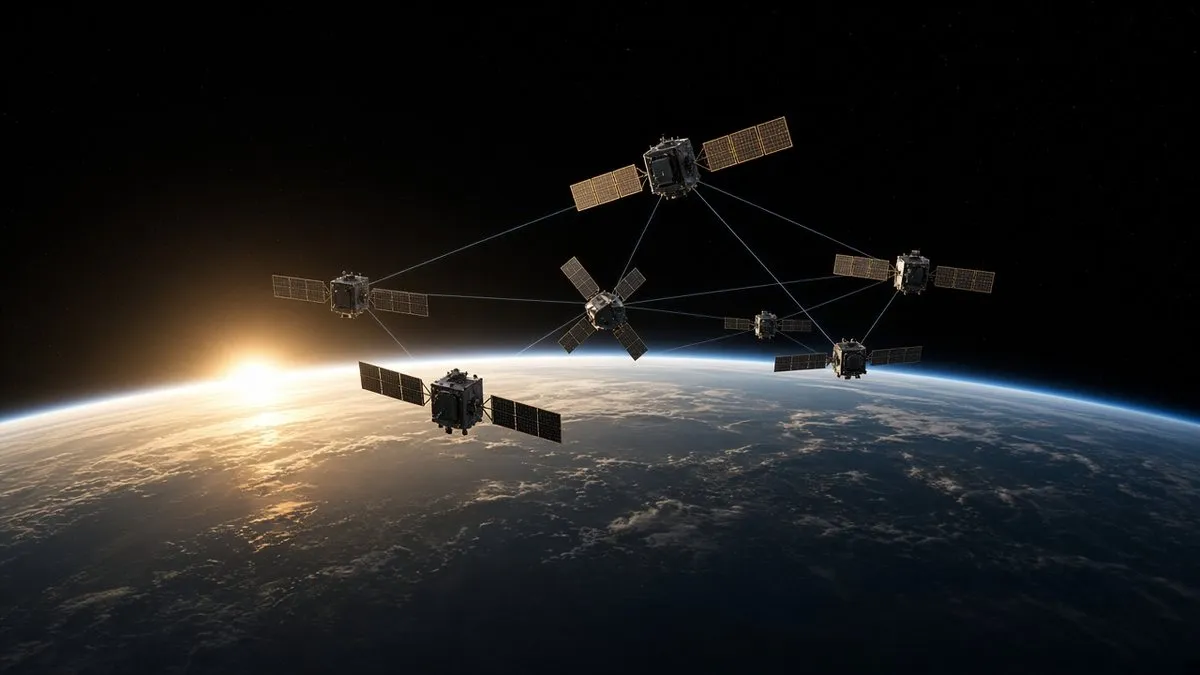
Google has booked a dedicated Blue Origin New Glenn launch for Project Suncatcher, its research effort to run AI computing on solar-powered satellites. The mission is targeted for the first quarter of 2029 and is meant to put satellites carrying Google's Tensor Processing Units (TPUs) into sun-synchronous orbit, each with roughly the computing capacity of a data center rack.
Both companies announced the launch services agreement on Thursday. Neither said how many satellites will fly, Via Satellite reported, and no price was announced. Google calls it the project's first heavy-lift launch and says it builds on its "ongoing work with other satellite and launch partners," so New Glenn is not described as the program's only ride.
From one prototype to rack-scale satellites
The booking is a step up in size from what Suncatcher has flown so far. Its first prototype, built with Planet, went up on October 1 on a SpaceX Falcon 9 rideshare that included several other payloads, The Verge noted. At the end of October, Google said that satellite had returned its first AI response from a data-center-class TPU in orbit, a haiku written by an onboard copy of the open Gemma 4 model and downlinked during a pass over Svalbard, Norway. We covered that milestone in our report on the first TPU prompt in orbit.
Google said the next work on that prototype is testing how the TPUs hold up under thermal stress and radiation, ahead of a milestone of twin interconnected satellites in 2027. The New Glenn flight sits after that on the roadmap. The companies have not said whether the 2029 payload is a full computing cluster or another demonstration step, and SpaceNews described it as a set of prototype data center satellites.
Why sun-synchronous orbit
The orbit choice follows the design Google laid out when it announced Suncatcher in November 2025. Google's researchers proposed flying the satellites in a dawn-dusk sun-synchronous low Earth orbit, where they would see near-constant sunlight. Google says a solar panel in the right orbit can be up to eight times more productive than on the ground and can generate power almost continuously, which cuts the need for heavy batteries.
The harder problem is networking. Large training and inference jobs spread work across many accelerators, and Google's paper says matching a ground data center would take links between satellites carrying tens of terabits per second. To get enough signal power for that, the design flies satellites in very tight formation. Google's illustrative layout is an 81-satellite cluster with a 1 kilometer radius at about 650 kilometers altitude, with neighboring satellites roughly 100 to 200 meters apart. A bench-scale optical link demonstrator reached 800 Gbps each way, 1.6 Tbps in total, on a single transceiver pair.
Radiation was the other open question. Google tested its Trillium (v6e) TPU in a 67 MeV proton beam. The high-bandwidth memory was the most sensitive part, showing irregularities only after a cumulative dose of 2 krad(Si), which Google says is nearly three times the expected shielded dose for a five-year mission. Orbit is where those lab results get checked.
A launch provider that is also a rival
The deal pairs Google with a company that wants to build its own orbital compute network. In March, Blue Origin asked the Federal Communications Commission for authority to launch up to 51,600 data center satellites under the name Project Sunrise, in sun-synchronous orbits between 500 and 1,800 kilometers, GeekWire reported. SpaceX is seeking FCC approval for a constellation of up to a million data center satellites, and startups including Starcloud are pursuing their own networks.
For Blue Origin, Google is a high-profile commercial customer for New Glenn, and the deal comes less than two weeks after NASA picked the company to land a nuclear-powered rover at the Moon's south pole. In its statement, Jordan Charles, Blue Origin's senior vice president of New Glenn, said the rocket's "heavy-lift capacity and large payload volume give customers the flexibility to bring new capabilities to orbit."
The economics still sit well in the future. Google's own analysis says launch prices may need to fall below $200 per kilogram, a level it projects for the mid-2030s, before launching and running a space data center could roughly match the energy costs of an equivalent facility on the ground. Google lists thermal management, high-bandwidth ground links and on-orbit reliability among the engineering problems still to solve. The next checkpoint is the twin-satellite demonstration Google has planned for 2027, with the New Glenn flight targeted for early 2029.